Session Three: Late 19th and Early 20th Century Occultism
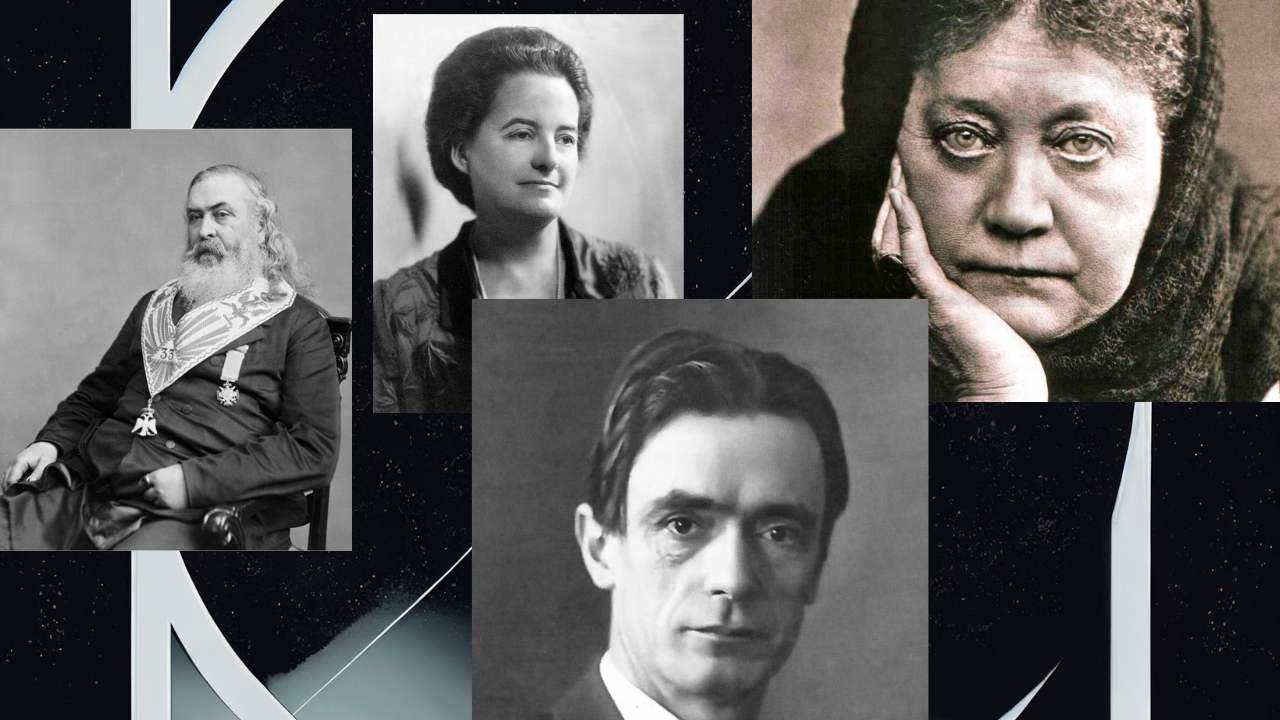
In our third meeting, we'll explore the influence of notable figures on the Western esoteric tradition in the late 19th to early 20th centuries. We'll start by examining Madame Blavatsky (1831-1891) who started the Theosophical Society. Blavatsky believed that Theosophy was not a religion or a philosophy, but rather a scientific effort to understand the laws that govern the universe. It was an early effort to meld Western and Eastern mysticism.
We'll also discuss Aleister Crowley (1875-1947) and Thelema, an esoteric philosophy that Crowley developed in the early 20th century. A raucous iconoclast, Crowley famously declared, "Do what thou wilt shall be the whole of the law," and believed he was the “Great Beast 666” of Revelation. The poet W.B. Yeats (1865-1939) joined the Golden Dawn, and started his own magical order. Yeats stated that "The mystical life is the center of all that I do and all that I think and all that I write."
We'll look at the impact of the Golden Dawn and its belief in the attainment of “the Knowledge and Conversation of the Holy Guardian Angel” as a means of achieving one's true will. Furthermore, we'll examine the influence of Madame Blavatsky’s Theosophy on modern Western spirituality. Rudolf Steiner broke off from Theosophy to start his own movement, Anthroposophy, with the goal of studying “the laws of the universe and man’s relation to them.”