Session Four: Modernist Occult Movements
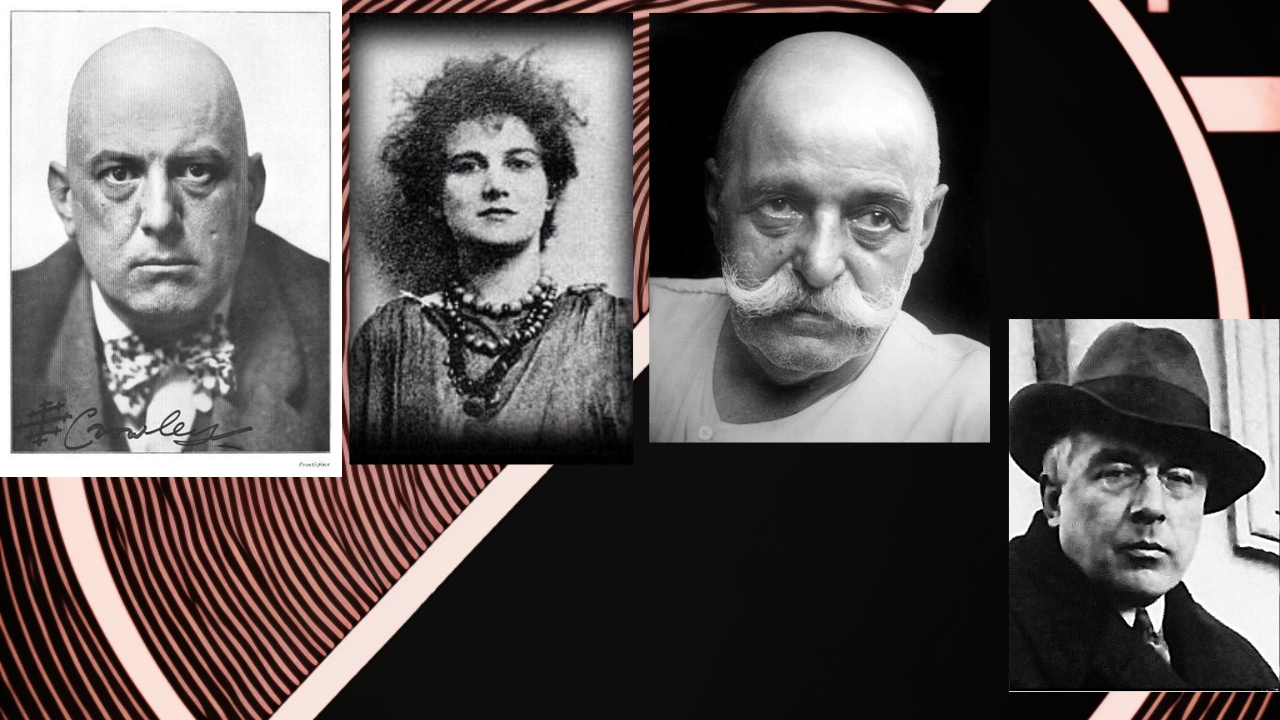
In our fourth weekly seminar, we'll examine several notable figures who contributed to the Western esoteric tradition in the 20th century. Alice Bailey was a theosophist who founded the Arcane School and wrote extensively on esoteric philosophy. She introduced the concept of the "Seven Rays," which is believed to be the seven fundamental energies that underlie all of creation.
Dion Fortune was a British occultist who founded the Society of the Inner Light and authored several influential books on magic and the Qabalah. She believed that magic was a practical tool for personal and spiritual development, and that the Qabalah offered a roadmap for understanding the universe and the self.
G.I. Gurdjieff was an influential spiritual teacher who founded the Gurdjieff Work, which focused on self-awareness and spiritual development through physical exercises and mental practices. He believed that most people lived their lives in a state of "waking sleep" and that self-awareness was the key to unlocking higher levels of consciousness.
P.D. Ouspensky was a student of Gurdjieff who went on to develop his own teachings on spiritual development, including the concept of "self-remembering." This concept involves bringing one's attention to the present moment and developing a more conscious, aware relationship with oneself and the world.
Austin Osman Spare was a British artist and occultist who developed his own unique system of sigil magic. He believed that the creation of personalized symbols, or sigils, could be used to manifest one's desires and bring about personal transformation.
Lastly, we'll discuss Rudolf Steiner, an Austrian philosopher and founder of Anthroposophy, which combined elements of Christianity, Theosophy, and esoteric science. Steiner believed in the existence of a spiritual world beyond the physical, and his work focused on developing a deeper understanding of the relationship between the spiritual and material realms.